
I have a build-first reflex and a brain that bounces off anything I have to maintain by hand. Every “second brain” I ever set up died the same way. Not because it was bad. Because keeping it tidy became a wall. Tagging, linking, filing — I'd burn an afternoon “organizing” and call it productive. It wasn't. It was procrastination in a productivity costume.
So about a year ago I stopped keeping notes I could read, and let an AI keep them instead. Not a weekend hack — I built it to still be running in ten years. Plain text, local, no cloud to pull the plug on me.
I wasn't crazy, just early
In April 2026 Andrej Karpathy — OpenAI co-founder — posted his version of the same idea: don't ask the AI questions, have it build and maintain a wiki of markdown files for you. “You rarely ever write or edit the wiki manually,” he wrote. “It's the domain of the LLM.” It went viral. Suddenly everyone was building a self-updating second brain.
One detail everyone skipped: Karpathy still reviews his in Obsidian. He kept a room he can walk into. I didn't. Mine is headless — no app, no graph to admire, no reading room. The AI is the only one who ever goes in.
AI vs no-AI is the wrong question
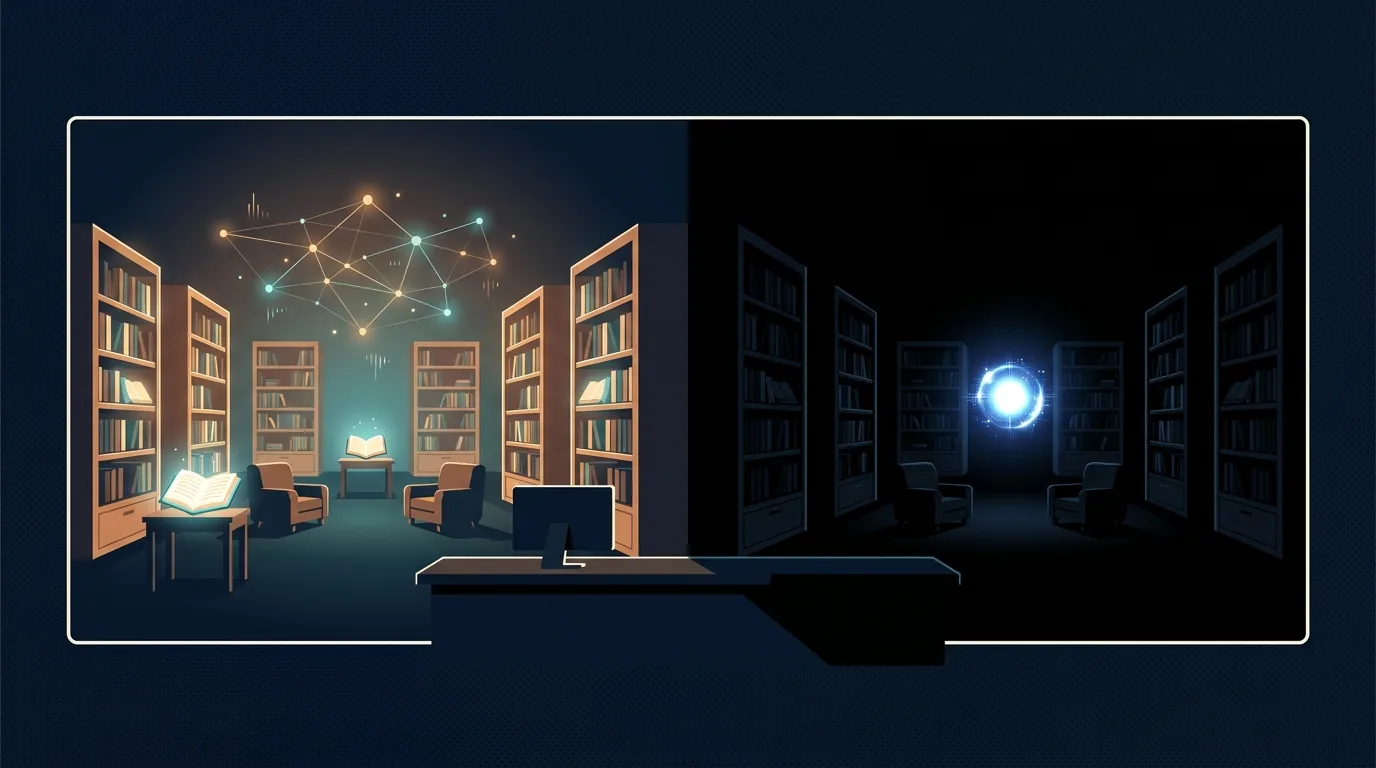
Picture your second brain as a library where an AI does the filing. In the popular version you keep the lights on: the AI writes the index cards and fetches for you, but the shelves are still there. You can walk in whenever you want, browse, and look at the map of how everything connects. Obsidian is that reading room.
In my version I locked the door and turned off the lights. The library is pitch black and the AI is the only one who ever goes in. Both are AI second brains. The difference isn't whether a machine does the work — that argument ended in April. It's whether you keep a room you can enter, or go fully dark.
I tried to prove mine was better
Here's where I'm supposed to tell you mine wins. Instead of taking my own word for it, I checked.
I built the thing, which makes me a biased judge. So I handed both setups to five AI models I use daily — across GPT, Gemini, Claude, GLM and Grok — and asked each, on its own, to compare them. Then I ran a real retrieval benchmark against Obsidian's own AI search.
On finding the right note, it's a tie. No clear winner — and that's on my own notes, the home turf that should have favoured mine. I'm not going to dress that up: if all you want is to find what you wrote, a good AI-powered Obsidian does the same job, with a graph and a phone app thrown in.
So why do I still use mine every day? Because finding notes was never the job.
What it actually wins at
What I built isn't a place I visit. It's working memory for the AI that does my actual work — and it does four things a vault doesn't:
- It shows up before I ask. Every session starts with the relevant bits already on the table. I never re-explain where I left off. Karpathy's wiki you open and query; mine volunteers. Zero ritual, no “let me go look”.
- It tracks how my mind changed. Not just what I decided — what replaced it, and what contradicts it. Old decisions don't get overwritten, they get marked superseded. It's a record of my thinking evolving, not a pile of current notes.
- It's governed, not just a folder. There's a read-only lane and a separate write lane, and a guard that flatly refuses destructive commands. A second AI can read my memory without being able to wreck it. My brain can't accidentally delete itself.
- It's mine, and built to last. Local files, plain text, no vendor, no plugin that dies in two years and takes my knowledge with it. In ten years it still opens.
None of that makes it better at search. It makes it a different tool doing a different job: a brain the AI thinks with while it works, not a brain I read.
The honest scorecard
| What matters | Headless (mine) | Obsidian-style (incl. Karpathy's method) |
|---|---|---|
| Who maintains it | The AI, automatically | The AI too — that's Karpathy's whole point |
| Finding the right note | A tie | A tie |
| Shows up before you ask | Yes, every session | No — you go and query it |
| Seeing the whole thing | Nothing to look at | A graph you can browse |
| When it breaks | Server down = brain offline | Still just files in an app |
| On your phone | Awkward | Proper mobile app |
So which should you use?
Most people: Obsidian, almost certainly. You get the same AI doing the filing, plus a map you can see and an app that works on the couch. Start there. Honestly.
Go headless like me only if you basically live inside an AI agent all day, you never browse your notes anyway, and what you actually want is a memory wired into the work that shows up uninvited. That's a narrow door. I walk through it because it's exactly my shape — build-first, allergic to upkeep, in a chat window from morning to night.
Five AIs and a benchmark told me my second brain doesn't win. I kept it anyway.
Because the best second brain isn't the one that scores highest. It's the one you'll still be using in six months — in my case, hopefully ten years. That's the only audit that counts. And it's the one you have to run on yourself, not borrow from me.
I build in public
The tools and experiments that come out of this — no subscription, no hype — live on my tools page. Have a look if you want to see what actually works.
See the tools →Background: Andrej Karpathy's “LLM wiki” note-taking method (April 2026); the term “second brain” comes from Tiago Forte's Building a Second Brain (2022). The five-model comparison and retrieval benchmark are my own, run on my own notes. Reference on Karpathy's method.